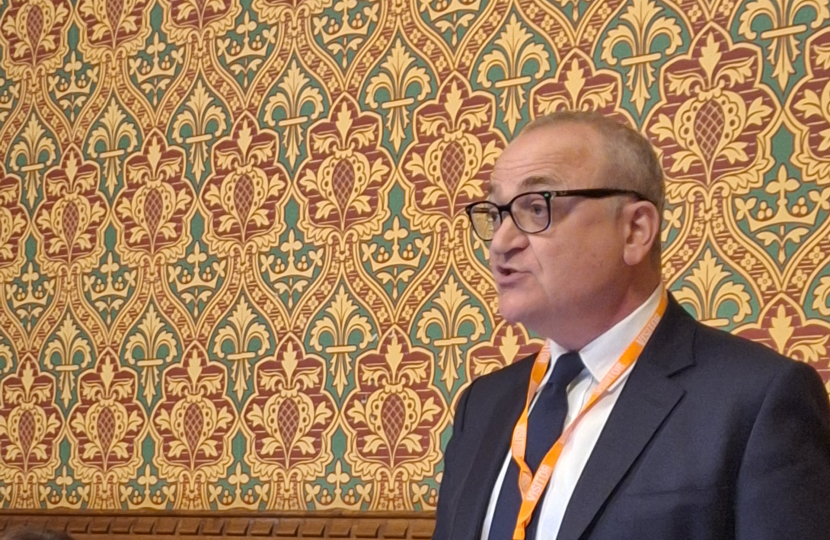
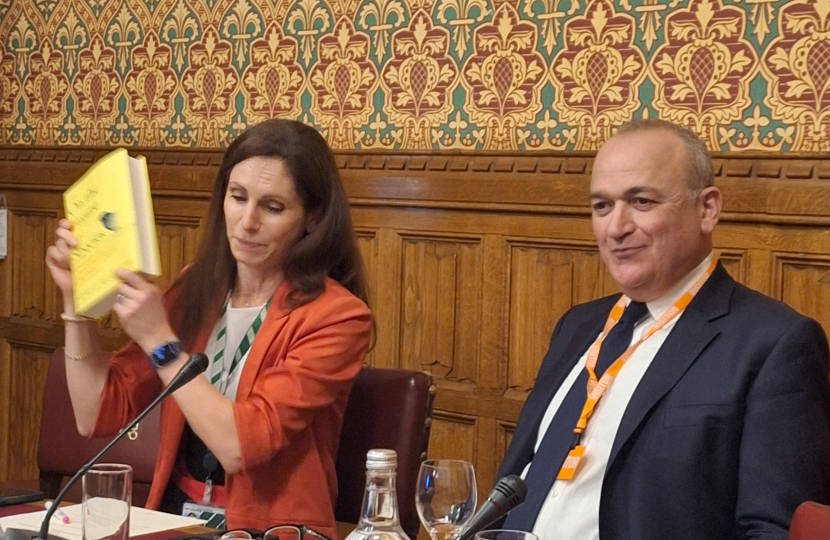
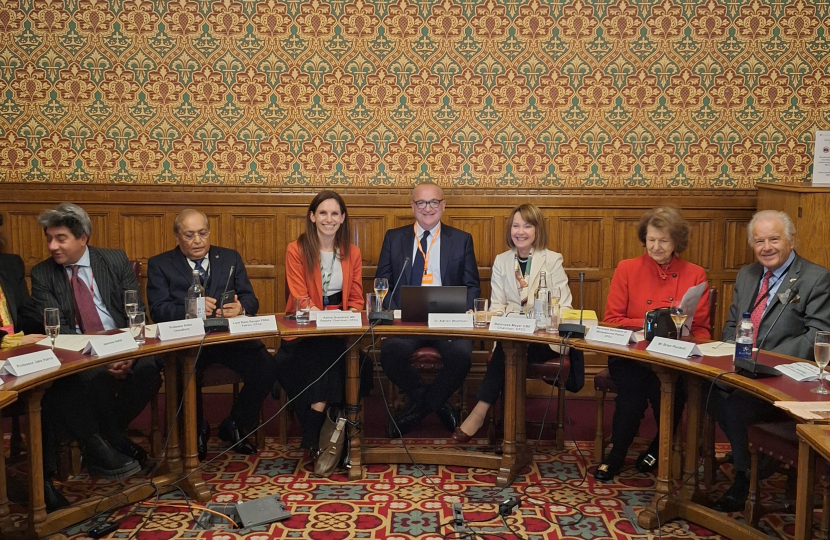
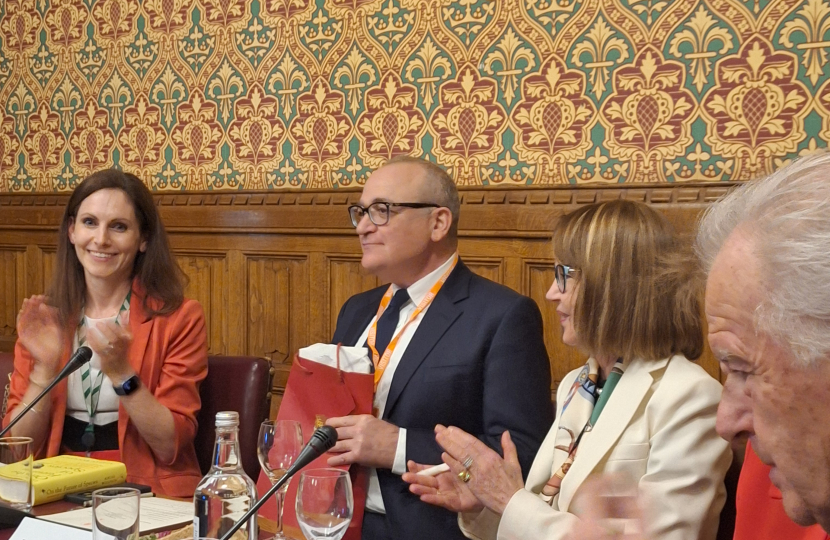
The Conservative Foreign and Commonwealth Council was delighted to host Dr. Adrian Woolfson, the Co-founder and CEO of Genyro, at Parliament to discuss his work and third book, the FT’s Book of the Week, On the Future of Species.
Following an introduction by CFCC President Baroness Meyer, Dr Woolfson thanked the CFCC for inviting him along with his guests and the fellow scientists that joined him for the special House of Lords event.
Dr. Woolfson asserted that whilst AI was clearly of considerable societal importance, synthetic biology, also known as generative biology, was potentially even more consequential, as through the convergence of AI with the ability to construct DNA, DNA could be designed and build at scale, all the way up to the size of genomes. He acknowledged that while we couldn’t at present quite create a new species for Baroness Meyer to take home with her, we were on our way to being able to do so.
Dr. Woolfson went on to remark that life would no longer be a phenomenon that we purely catalogued and observed. We would, instead, be able to contemplate building new biological entities from first principles, thereby going beyond the products of natural Darwinian evolution. In doing so, he stressed the importance of treasuring natural species, which in addition to their intrinsic value, will help us to piece together an eventual instruction manual that may help us to understand the nature of humankind and indeed of all living species.
Dr. Woolfson noted the significance of our gathering on Commonwealth Day and suggested that the current upheaval in the world order made the shared history and values of the Commonwealth more relevant than ever.
Comprising 56 nations, and 2.7 billion individuals representing one third of humanity, he recounted King Charles’ speech given earlier that day, which stated that by “working together, we can ensure that the Commonwealth continues to stand as a force for good – grounded in community… enriched by culture [and] steadfast in its care for our planet”.
Dr. Woolfson discussed New Atlantis published in 1626, in which the visionary English philosopher Francis Bacon asserted that humankind could manipulate nature for its own benefit. In imagining the possibility of altering nature 'by art’, and making species ‘greater than their nature’, Bacon anticipated the possibilities of contemporary generative biology.
In contemplating how medical advances might potentially significantly increase the human health span and life span, Dr Woolfson asked the audience to ponder some of the potential consequences of such advances, which are often ignored. Would it, for example, be ‘natural’ to live to the age of 150, or longer?. If we did, how might that impact human nature as we currently experience it?
Would, for example, the nineteenth century poets, writers, and artists have had the same urgency to produce ‘works of consequence’ if they knew that they might live much longer than the average 30 years of life expectancy common at that time?
Dr. Woolfson suggested that biology may be viewed as ‘the new steel’, transitioning from an artisanal material into infrastructure. The utility of biology, however, is far broader than that of steel, being applicable to a wide range of areas, including the sustainable generation of energy, DNA information storage, rewriting the genomes of crops to make them drought resistant, heat resistant, and to increase yields, and forming the substance of new biomaterials. The ability to reverse engineer human biology through the elucidation of the generative ‘rules of biology’ is also expected to result in significant medical breakthroughs. Cancer for, example, may eventually become as preventable and curable as infectious diseases.
He suggested that the UK should take a proactive leadership role in investing in the emerging multi-trillion-dollar global bioeconomy, leveraging the talent and biological resources in both the UK and the extended Commonwealth network. Our partners could become impactful global biotechnology hubs, thereby helping to reinvent the Commonwealth for today, and imbuing it with a new relevance.
Dr Woolfson reminded us that the shared values of the Commonwealth could no longer be taken for granted. In an increasingly fragmented world, the Commonwealth provides the opportunity of providing a new focus and centre of gravity around which shared beliefs and values can be consolidated.
Through his proposed Commonwealth ‘Bio-Design’ vision, Dr Woolfson indicated that the 56 nations comprising the Commonwealth could be unified within the structure of a new and aligned economic and scientific purpose focused on addressing global challenges including food production, climate change, healthcare, and the preservation of global biodiversity.
While having the potential to create significant economic benefit, unity, and alignment of purpose across the Commonwealth nations, the proposed initiative would also help ensure that that we become responsible stewards of life on Earth and that generative biology is managed wisely and ethically. An initiative that he hoped we at the CFCC could be instrumental in building upon.
Jamila Robertson
Commonwealth Day 2026
Dr Adrian Woolfson
‘Designing Life with AI: Shaping a Resilient Commonwealth in the Age of Biological Innovation’
For the first time, humanity is learning how to design life itself - and the Commonwealth has a unique opportunity to ensure that this power is used responsibly, equitably, and for the benefit of all nations.
Theme of Commonwealth Day is Unlocking Opportunities for All
Commonwealth Day 2026 focuses on unlocking opportunities for all | Commonwealth
Adrian Woolfson was born in London, he studied medicine at Balliol College, Oxford, molecular genetics at Gonville and Caius College Cambridge, and was formerly the Charles and Katherine Darwin Research Fellow at Darwin College, Cambridge, where he worked with Nobel Prize Winer César Milstein in the Division of Protein and Nucleic Acid Chemistry at the MRC Laboratory of Molecular Biology. He is the co-founder of Genyro, a California-based biotechnology company specialising in AI-augmented synthetic genome design and construction. Adrian has published the critically acclaimed Life Without Genes: The History and Future of Genomes and An Intelligent Person’s Guide to Genetics. He has authored over 160 scientific papers, book chapters, reviews, and patents, contributed to multiple publications including the Washington Post, Nature, The Spectator, The Literary Review, Prospect Magazine, The Times Literary Supplement, London Review of Books, and Financial Times, and is a regular contributor to the Wall Street Journal and Science magazine. He currently lives in San Francisco.
On The Future of Species
Link for the book: https://bit.ly/49cPJKJ